



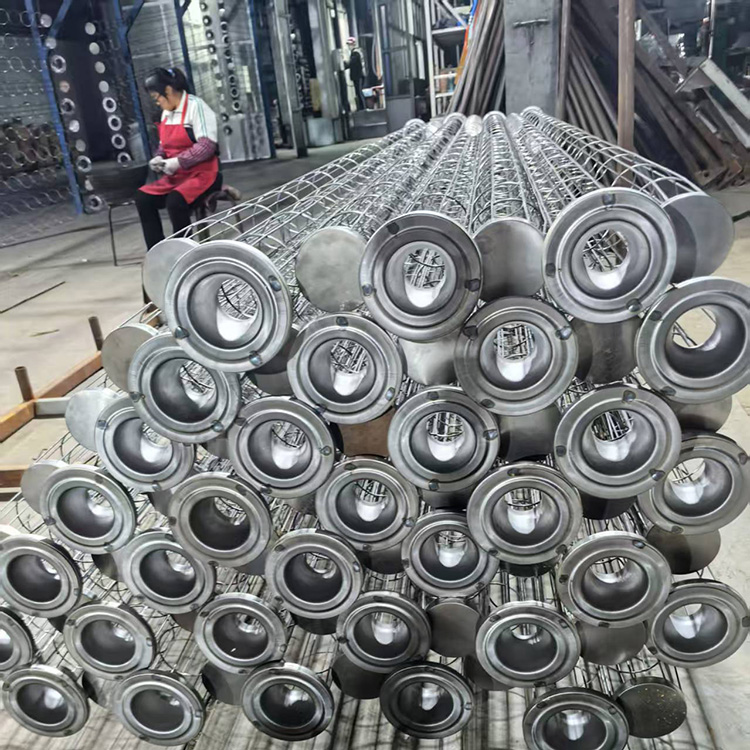
Filter Cages
Filter Cages Filter cages are essential support components inside baghouse and industrial dust collection systems, designed to maintain the shape of filter bags and prevent them from collapsing under negative pressure and airflow resistance...
Filter Cages
Filter cages are essential support components inside baghouse and industrial dust collection systems, designed to maintain the shape of filter bags and prevent them from collapsing under negative pressure and airflow resistance. Properly designed filter cages improve filtration stability, dust removal efficiency, and filter bag service life.
Structural Composition of Filter Cages
A typical filter cage consists of:
Vertical support wires
Horizontal rings
Top connection
Bottom support
The cage structure must provide sufficient rigidity while maintaining a smooth surface to prevent damage to the filter bag.
The dimensional accuracy and structural strength of the cage directly affect the operating performance of the complete filtration assembly.
Main Function of Filter Cages
During operation, pressure differences can cause filter bags to deform inward. The filter cage provides internal support and maintains the designed filtration area.
Its main functions include:
Maintaining bag shape
Preventing bag collapse
Supporting pulse-cleaning operations
Reducing mechanical deformation
Improving airflow stability
A properly matched cage allows the filter bag to operate efficiently throughout repeated cleaning cycles.
Material Selection
Common filter cage materials include:
Carbon steel
Stainless steel
Galvanized steel
Stainless steel cages are particularly suitable for corrosive, humid, high-temperature, or hygienically controlled environments.
Material selection should consider operating temperature, dust characteristics, moisture, chemical exposure, and expected service life.
Surface Treatment
Surface treatment can improve corrosion resistance and durability.
Common options include:
Galvanizing
Silicone coating
Epoxy coating
Stainless steel finishing
The cage surface should be smooth and free from sharp edges, burrs, or welding defects that could damage the filter fabric.
Dimensional Matching
Filter cages must match the corresponding filter bags in diameter, length, and connection structure.
Improper dimensions may cause:
Bag deformation
Excessive friction
Poor dust cleaning
Installation difficulties
Premature filter bag wear
The cage and filter bag should be treated as a matched filtration assembly rather than independent components.
Welding Quality Requirements
Welded joints are important structural points.
Inspection should focus on:
Weld strength
Surface smoothness
Joint integrity
Dimensional consistency
Poor welding may create sharp projections or weak connections, increasing the risk of filter bag damage during operation.
Influence on Dust Removal Performance
The cage design affects how effectively dust can be removed from the filter surface.
An appropriate cage structure allows the bag to expand and contract during pulse cleaning, helping remove accumulated dust and restore airflow resistance.
The correct cage geometry contributes to stable filtration efficiency and longer filter bag operating life.
Installation and Maintenance
Before installation, cages should be checked for:
Deformation
Corrosion
Broken wires
Sharp edges
Incorrect dimensions
Damaged cages should be replaced or repaired before operation.
Regular inspection helps prevent unexpected filter bag damage and equipment downtime.
Conclusion
Filter cages play a critical supporting role in industrial dust collection systems. Through appropriate material selection, accurate dimensions, reliable welding, smooth surface treatment, and correct matching with filter bags, manufacturers can improve filtration reliability and reduce maintenance requirements.
A properly designed filter cage helps maintain filter bag shape, support efficient pulse cleaning, prevent premature wear, and extend the service life of the entire dust collection system.
References
ISO 16890 – Air Filters for General Ventilation
ASHRAE Standard 52.2 – Method of Testing General Ventilation Air-Cleaning Devices
NFPA 652 – Standard on the Fundamentals of Combustible Dust
ASTM A123/A123M – Standard Specification for Zinc Coating on Iron and Steel Products
ISO 9001 – Quality Management Systems Requirements
ASTM D737 – Standard Test Method for Air Permeability of Textile Fabrics