



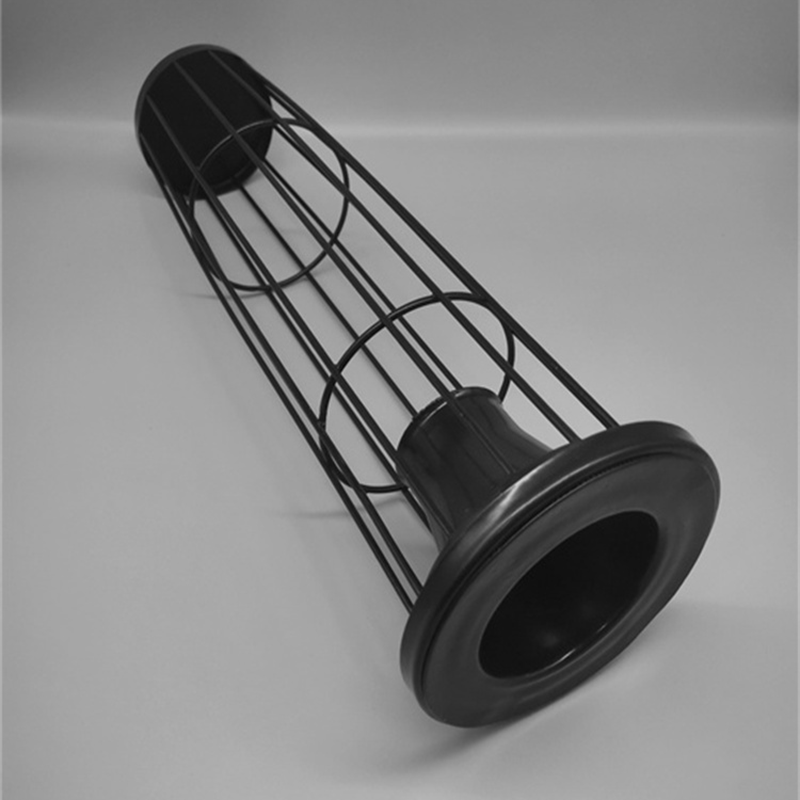
Filter Cages
The dust collector skeleton, also commonly referred to as dust filter bag cage or dust removal frame, is the core supporting component of a baghouse dust collector, which directly determines the service life of filter bags and the operation...
The dust collector skeleton, also commonly referred to as dust filter bag cage or dust removal frame, is the core supporting component of a baghouse dust collector
which directly determines the service life of filter bags and the operational efficiency of the entire dust removal system.
I. Core Functions
Support and Protect Filter Bags: Maintain the stable shape of filter bags to prevent them from collapsing, deforming or getting damaged during the filtration and ash cleaning processes.
Guarantee Filtration Efficiency: Enable dust-laden airflow to pass through the filter bags evenly, avoiding the local concentration of airflow that would impair the dust separation effect.
Adapt to Complex Working Conditions: Through optimizations in materials and surface processes, it can adapt to special industrial environments such as high temperature and high corrosion.
II. Mainstream Classifications
Classified by Shape
Round Skeleton: A universal model for conventional round-bag dust collectors, featuring a simple structure and convenient installation.
Oval/Trapezoidal Skeleton: Adapted for special-shaped filter bags, it optimizes the utilization rate of the internal space of the equipment and is suitable for high-pressure ash cleaning scenarios.
Spring Skeleton: With built-in flexibility, it is suitable for dust collectors with narrow top spaces, facilitating installation and replacement.
Star/Envelope-shaped Skeleton: Designed for specially customized dust collectors to meet differentiated installation requirements.
Classified by Material
Carbon Steel Skeleton: Low in cost, it is applicable for ordinary working conditions at room temperature with low corrosion.
Galvanized Skeleton: Treated by hot-dip galvanizing, it has excellent rust resistance, balancing cost-effectiveness and durability.
Stainless Steel Skeleton: Made of 304/316 materials, it is resistant to acid and alkali corrosion, suitable for highly corrosive scenarios such as the chemical industry and waste incineration.
Classified by Assembly Form
Integral Skeleton: Formed by one-piece welding, it boasts high structural strength and is applicable for filter bags of conventional lengths.
Multi-section/Lower-discharging Skeleton: Assembled in sections, it reduces the operational difficulty of replacing filter bags at high altitudes and minimizes component wear.
III. Materials and Processes
Raw Materials: Most of the skeletons are made of high-quality low-carbon steel wire, galvanized steel wire or stainless steel wire, with a common wire diameter of 3.2-4.0 mm.
Welding Process: Formed in one go by a multi-head high-frequency welding machine, the welding points are firm without any weld-off, cold solder or missed weld, and the surface is smooth without burrs.
Surface Treatment: Processes such as galvanizing, plastic spraying and organic silicon spraying are supported, which greatly improve the corrosion resistance to adapt to different working conditions.
IV. Core Performance Characteristics
Qualified Strength and Rigidity: The longitudinal ribs and support rings are evenly distributed, which can withstand the gas pressure and mechanical impact during the filtration and ash cleaning processes.
Strict Precision Control: The verticality error within a length of 6 meters does not exceed ±1 mm, ensuring accurate alignment during filter bag installation.
Long Service Life: It can operate stably for more than 3 years under normal working conditions, greatly reducing the wear probability of filter bags and extending their replacement cycle.
Easy Installation and Maintenance: The overall lightweight design eliminates the need for complicated daily maintenance, and only requires careful handling during transportation and installation.
V. Application Scenarios
It is widely used in industrial dust control fields such as metallurgy, chemical industry, coking, power generation, steel, building materials, coal mines and waste incineration, serving as the core supporting component of pulse baghouse dust collectors.